Best overall: an interior detail scoped around smoke contamination. Best for fabric-focused odors: targeted upholstery and carpet cleaning. Best for routine upkeep: full-service interior cleaning. This 2026 guide helps Farmingdale drivers choose the right work, separate cleaning from fragrance, and avoid confusing exterior wash coverage with interior care.
- The best car interior cleaning for smoke odor removal starts with locating and cleaning contaminated materials, not adding fragrance.
- Cruzinwash offers interior cleaning and detailing in Farmingdale; confirm smoke-specific work before booking.
- Choose upholstery cleaning for affected fabrics and a broader interior assessment when the odor source is unclear.
- An exterior wash membership is not a substitute for separately scoped interior cleaning or detailing.
Why this matters
Smoke odor is not the same job as crumbs on a seat. Tobacco residue can remain on interior surfaces and materials, so a tidy-looking cabin does not establish that the underlying contamination has been removed.
For local service, Cruzinwash offers full-service interior cleaning and detailing in Farmingdale. Ask which service addresses your vehicle’s condition before booking; the service name alone does not establish a smoke-removal process or a guaranteed result.
Choose an interior cleaning service by the surfaces it addresses, not by how strongly the cabin smells of fragrance afterward. That distinction matters whether you bought a used vehicle or want to stop carrying an old smoke smell on your commute.
What makes the best smoke-odor interior cleaning
Use these criteria when comparing your 2026 options:
- Source assessment: The provider asks about smoking history, affected areas, and when you notice the smell.
- Material coverage: The scope identifies seats, carpets, mats, hard surfaces, and any other affected materials.
- Material-safe methods: Cleaning follows the vehicle manufacturer’s care instructions, especially around headliners, screens, and leather.
- Clear exclusions: You know whether ventilation-system investigation, filter work, or specialist treatment sits outside the job.
- Result expectations: The provider distinguishes cleaning from scenting and does not promise an unsupported permanent result.
- Separate service scope: Your exterior wash, interior cleaning, and detailing work are clearly distinguished.
A useful estimate describes work, not just an outcome. Ask what gets cleaned and what happens if the smell remains after the cabin dries.
Interior cleaning options at a glance
These are service approaches, not named packages. Use this 2026 comparison to decide what to discuss with a provider; do not assume every method is included in a local service menu.
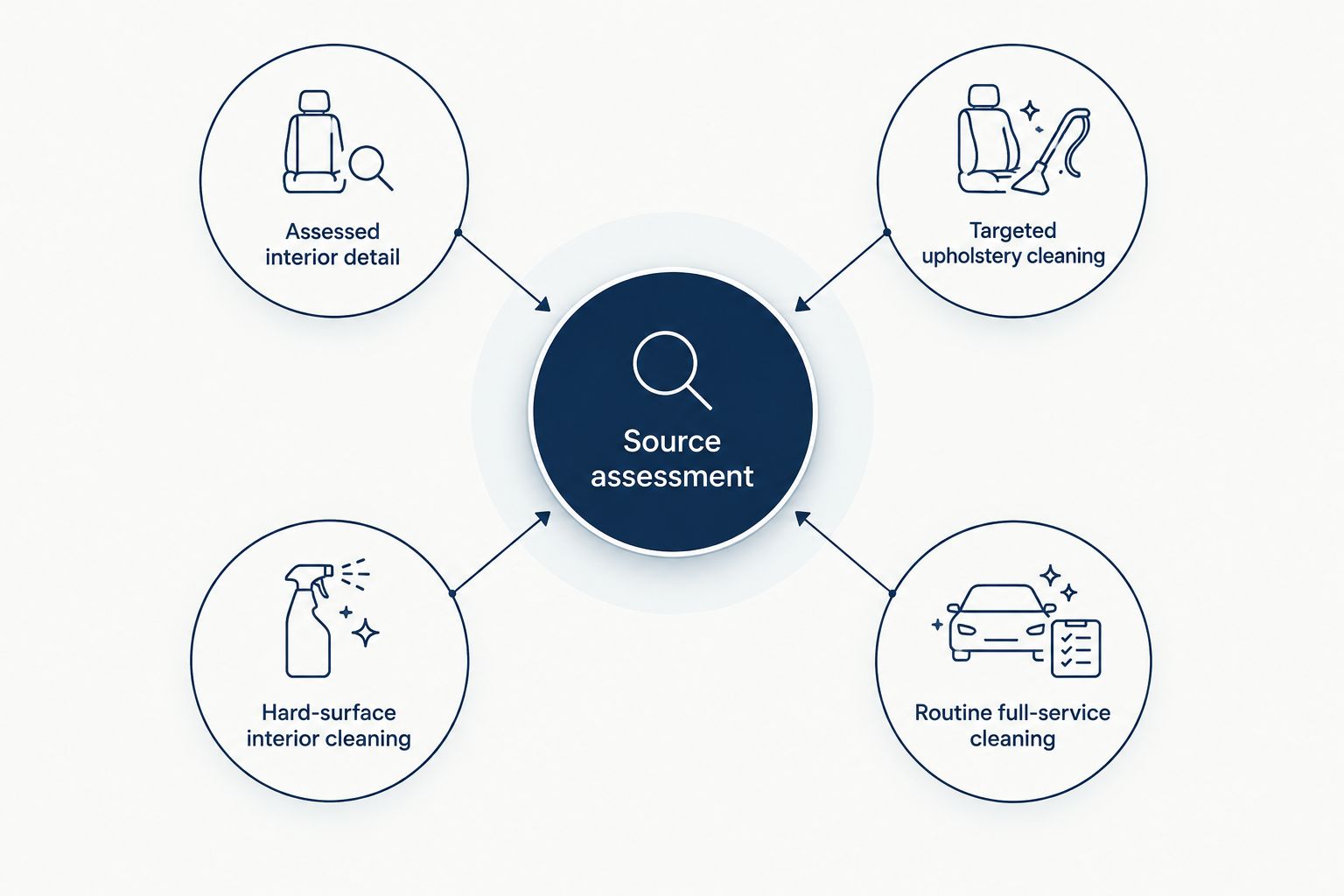
| Rank and option | Best for | Standout feature | Key limitation |
|---|---|---|---|
| 1. Assessed interior detail | Persistent odor across the cabin | Scope built around affected materials | A detail label alone does not confirm smoke treatment |
| 2. Targeted upholstery cleaning | Odor concentrated in fabric seats or carpets | Focuses cleaning on affected textiles | Leaves other odor sources outside its scope |
| 3. Hard-surface interior cleaning | Residue on cleanable trim and glass | Addresses accessible non-fabric surfaces | Does not clean embedded contamination in fabrics |
| 4. Routine full-service cleaning | Maintaining a cabin after source-focused cleaning | Handles ordinary interior upkeep | Not a substitute for a smoke-specific assessment |
The distinction is coverage. A narrow service makes sense when the affected area is known; a cabin-wide problem needs a broader conversation before you authorize work.
1. Assessed interior detail: best for persistent cabin-wide odor
An assessed interior detail starts with the condition of the whole cabin rather than a preset assumption about the smell. Ask the provider to identify the materials covered and explain which concerns require separate work.
Best for: A used vehicle with an unclear smoking history, or a cabin where the smell does not seem limited to one area.
Assessed interior detail pros:
- Lets you discuss several affected materials in the same scope.
- Creates a clear opportunity to flag headliner and ventilation concerns.
- Separates ordinary dirt removal from the smoke-odor objective.
Assessed interior detail cons:
- The word detailing does not establish which treatments are included.
- Cleaning accessible surfaces does not guarantee complete odor removal.
- Specialist work can sit outside the agreed scope.
Cruzinwash is best for Farmingdale drivers seeking a local interior-cleaning or detailing consultation before choosing a service. Confirm the smoke-specific scope directly; do not assume a general detail includes extraction, headliner cleaning, or ventilation work.
Verdict: Buy a clearly scoped interior detail after the provider assesses the smoke concern; hold if the description stops at fragrance.
2. Targeted upholstery cleaning: best for fabric-focused odor
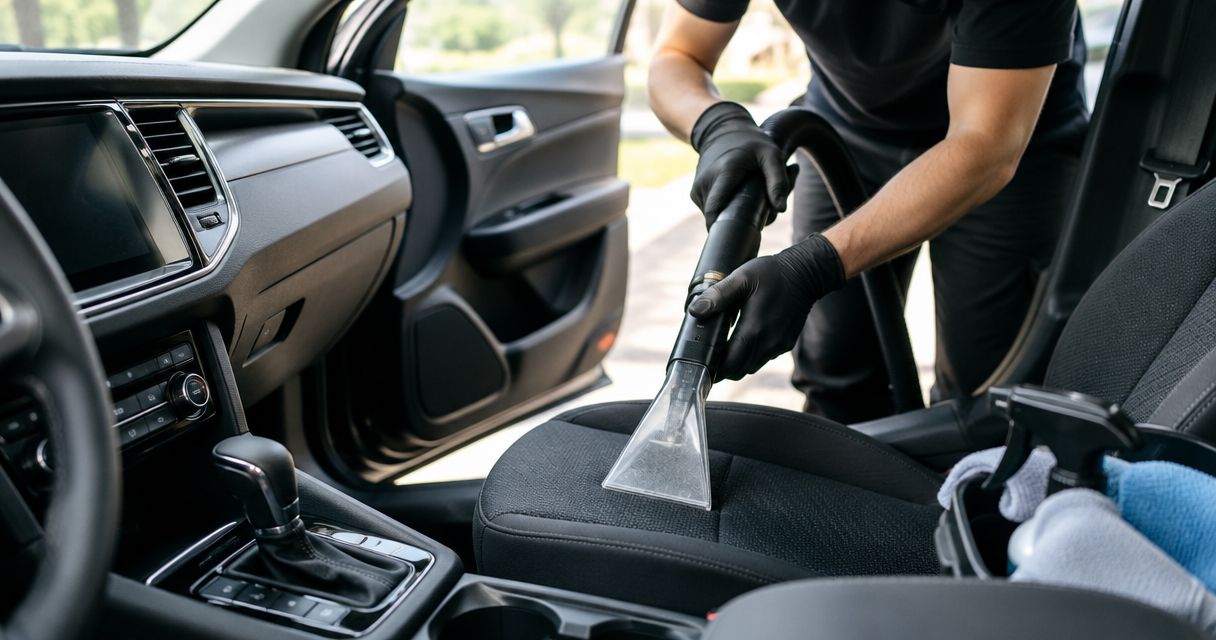
Targeted upholstery cleaning concentrates on affected fabric seats, carpets, or removable mats. The appropriate method depends on the material and its care instructions; extraction and other wet-cleaning methods are not suitable for every component.
Best for: A vehicle where the concern is concentrated in identified fabric areas rather than spread throughout the cabin.
Targeted upholstery cleaning pros:
- Keeps attention on the textiles you identify as affected.
- Gives you a specific scope to discuss and inspect.
- Separates fabric work from unrelated exterior washing.
Targeted upholstery cleaning cons:
- Does not address untreated trim, headliners, or ventilation components.
- Wet-cleaned materials need appropriate drying.
- Fabric cleaning alone does not establish that all smoke residue is gone.
Ask whether the service covers seat surfaces only or also carpets and mats. Explain any previous cleaning attempts so the provider knows what has already been applied.
Do not request aggressive soaking as a shortcut. More moisture is not a substitute for a material-safe process and a clear drying plan.
Verdict: Buy targeted upholstery cleaning when the affected textiles are identified; hold when the source remains unclear.
3. Hard-surface cleaning: best for accessible interior residue
Hard-surface interior cleaning addresses compatible trim, glass, and other accessible non-fabric areas. It belongs in the conversation because smoke contamination is not limited to upholstery.
Best for: Addressing residue on cleanable hard surfaces, especially when you are also checking whether fabrics need attention.
Hard-surface cleaning pros:
- Addresses surfaces that fabric-only cleaning leaves untouched.
- Gives you a defined list of areas to include.
- Can form part of a broader interior-cleaning scope.
Hard-surface cleaning cons:
- Does not remove contamination from untreated fabric or foam.
- Different finishes require different care methods.
- A wiped-down cabin can still have unresolved odor sources.
Ask the provider to distinguish cleaning from dressing or scenting. A glossy finish is a different outcome from removing surface residue.
For your 2026 service request, name the concern plainly: smoke odor, not just a request to make the dashboard look better. That helps keep the conversation focused on cleaning rather than appearance alone.
Verdict: Buy as a defined part of source-focused cleaning; skip as a stand-alone answer to persistent cabin-wide smoke odor.
4. Full-service interior cleaning: best for ongoing upkeep
Routine full-service interior cleaning serves a different purpose from a smoke-focused detail. Confirm the actual tasks before booking rather than assuming the label includes deep fabric cleaning or odor treatment.
Best for: Keeping up with ordinary interior mess after the smoke concern has been assessed and addressed.
Full-service interior cleaning pros:
- Gives you a separate option for regular interior care.
- Keeps maintenance distinct from a deeper corrective job.
- Lets you discuss everyday dirt without automatically requesting detailing.
Full-service interior cleaning cons:
- Routine service does not establish a smoke-removal scope.
- Deep textile or specialist work needs separate confirmation.
- Repeating a limited service does not address materials it never cleans.
If you drive around Farmingdale for work or school runs, separate the immediate odor problem from your maintenance routine. Solve the defined interior concern first, then choose the upkeep that matches how you use the vehicle.
Verdict: Buy for maintenance; skip as your only response to persistent smoke odor unless the confirmed scope addresses it.
Ask these 4 questions before booking
A useful 2026 booking conversation ends with a clear scope, not a vague promise. Have these questions ready:
- Which materials are included? Ask about seats, carpets, mats, trim, glass, and the headliner individually.
- What is outside the job? Confirm whether ventilation investigation, filter work, or other specialist work needs separate attention.
- How should I handle drying and pickup? Get instructions for your vehicle and the method being used rather than assuming a standard turnaround.
- How will the result be assessed? Agree on what happens if the odor remains after cleaning and drying.
Describe when you notice the smell. Mention whether it appears with the ventilation running, after the car has been closed, or near a particular seat; these are observations to share, not a diagnosis to make yourself.
Do not judge the job only by the scent at handover. Fragrance changes what you smell, but fragrance alone does not demonstrate that contaminated material has been cleaned.
Keep exterior membership and interior work separate
An exterior wash cleans the outside of your vehicle. It does not clean cabin upholstery, carpets, or interior trim, so it is not the service to choose for smoke odor.
Cruzinwash offers monthly unlimited wash club memberships alongside interior cleaning, hand washing, and detailing. Confirm the current membership coverage and ask separately about the interior work you need; do not assume that joining adds smoke treatment or detailing.
Before signing up, read about whether an exterior wash club membership includes interior cleaning. Keep these as 2 separate decisions: the service needed to address the cabin now, and the exterior-wash arrangement you want afterward.
How these options are ranked
This ranking puts source assessment and material coverage ahead of appearance or fragrance. It is a service-selection guide, not a claim that named providers have undergone comparative testing.
A broader assessed detail ranks first for an unclear, persistent problem. Targeted cleaning ranks next when the affected material is known, while routine full-service cleaning fits maintenance rather than an assumed smoke-removal job.
Which interior cleaning should you choose?
Default to an interior assessment followed by a written, material-specific scope when smoke odor persists. Choose targeted upholstery cleaning only when the fabric concern is identified, and include compatible hard-surface cleaning where needed.
Do not buy a bigger-sounding package without checking its tasks. The right service is the one that addresses the affected materials and explains its limits.
FAQ
What is the best car interior cleaning for smoke odor removal?
The best starting point is an interior assessment followed by cleaning scoped to the affected materials. A general detail name does not establish that upholstery, hard surfaces, the headliner, or ventilation concerns are covered.
Can a full-service car wash remove cigarette smoke odor?
A full-service wash is not automatically a smoke-odor treatment. Confirm the included interior tasks and ask whether the provider recommends a separate detail or specialist assessment.
Does Cruzinwash offer interior cleaning in Farmingdale?
Cruzinwash offers full-service interior cleaning and detailing in Farmingdale, New York. Confirm which service is appropriate for smoke odor and which tasks are included before booking.
Does an exterior wash membership clean smoke odor inside my car?
No. Exterior washing does not clean cabin materials, so arrange interior cleaning separately and confirm the current membership terms.
Is upholstery shampooing enough to remove smoke odor?
Upholstery cleaning alone does not establish that every smoke-contaminated surface has been addressed. Ask about other affected materials and follow the vehicle's care instructions for cleaning methods.
Should I request ozone treatment for car smoke odor?
Do not treat ozone as a substitute for source-focused cleaning. The EPA identifies ozone as a lung irritant; discuss any proposed treatment's safety requirements with a qualified provider and never occupy a vehicle during ozone treatment.
How do I compare smoke-odor cleaning estimates in 2026?
Compare the materials cleaned, methods, exclusions, drying instructions, and stated limits. A detailed scope is more useful than an unsupported promise of complete odor removal.
One last thing
Ask about the headliner before anyone starts. It is easy to focus on seats and carpets while leaving the overhead material out of the conversation, and headliners need care that suits their construction.
Do not request soaking or aggressive scrubbing. Ask whether the headliner is included, what method is appropriate, and what remains outside the agreed service.